Shifting Rewards: The Development of Redemption Options in Poker Loyalty Schemes
Olivia Wagner · Aug 24, 2026

Shifting Rewards: The Development of Redemption Options in Poker Loyalty Schemes
Poker room loyalty programs have undergone substantial changes in their redemption structures since the late twentieth century, moving from limited cash equivalents toward broader selections that encompass merchandise, event access, and travel packages, according to industry reports from the American Gaming Association. Early systems in land-based venues focused primarily on converting accumulated points into free play credits or small cash rebates, while operators tracked participation through physical cards that players presented at tables. Data from the Nevada Gaming Control Board shows that these initial offerings emphasized direct monetary returns to encourage repeat visits during the 1990s expansion of casino properties across the southwestern United States.
Initial Structures and Limited Choices
Operators designed the first redemption frameworks around straightforward exchanges where points translated into table credits or basic amenities such as discounted meals, yet these options left little room for personalization because the available categories remained narrow. Players accumulated points based on hours played and average bet size, and they redeemed them at dedicated counters that handled only a handful of preset rewards. Researchers at the University of Nevada, Las Vegas documented how these programs prioritized volume of play over diversity, which aligned with the operational priorities of brick-and-mortar rooms that sought steady table occupancy rather than varied engagement metrics.
Expansion Through Digital Integration
Digital platforms introduced new layers during the mid-2000s when online poker operators began linking loyalty points to virtual goods and tournament entries, creating pathways that blended cashback with entry into satellite events. This shift occurred alongside the growth of major sites that tracked player activity through software algorithms capable of offering tiered redemptions unavailable in earlier physical systems. Data indicates that redemption menus expanded to include branded apparel, electronic devices, and travel vouchers as operators competed for user retention across international markets. Observers note that Canadian regulatory frameworks, administered through bodies such as the Alcohol and Gaming Commission of Ontario, permitted similar expansions in provincial poker rooms where point systems incorporated charity donations as an additional category.
Modern Categories and Player Options
Contemporary poker reward programs present redemption menus that span multiple categories, ranging from direct cash conversions and merchandise to experiential rewards such as private tournament buy-ins and hospitality packages at major events. Industry analyses reveal that players can now allocate points toward hotel stays, spa services, or even fractional ownership of high-value items through partnered vendors, whereas earlier decades restricted choices to immediate monetary equivalents. Figures from European gaming associations show that programs in regulated markets outside the United Kingdom have incorporated sustainability-linked rewards, allowing point exchanges for carbon offset contributions or community project funding. One notable development involves partnerships with third-party platforms that convert poker points into airline miles or hotel loyalty credits, thereby linking casino rewards with broader consumer ecosystems.
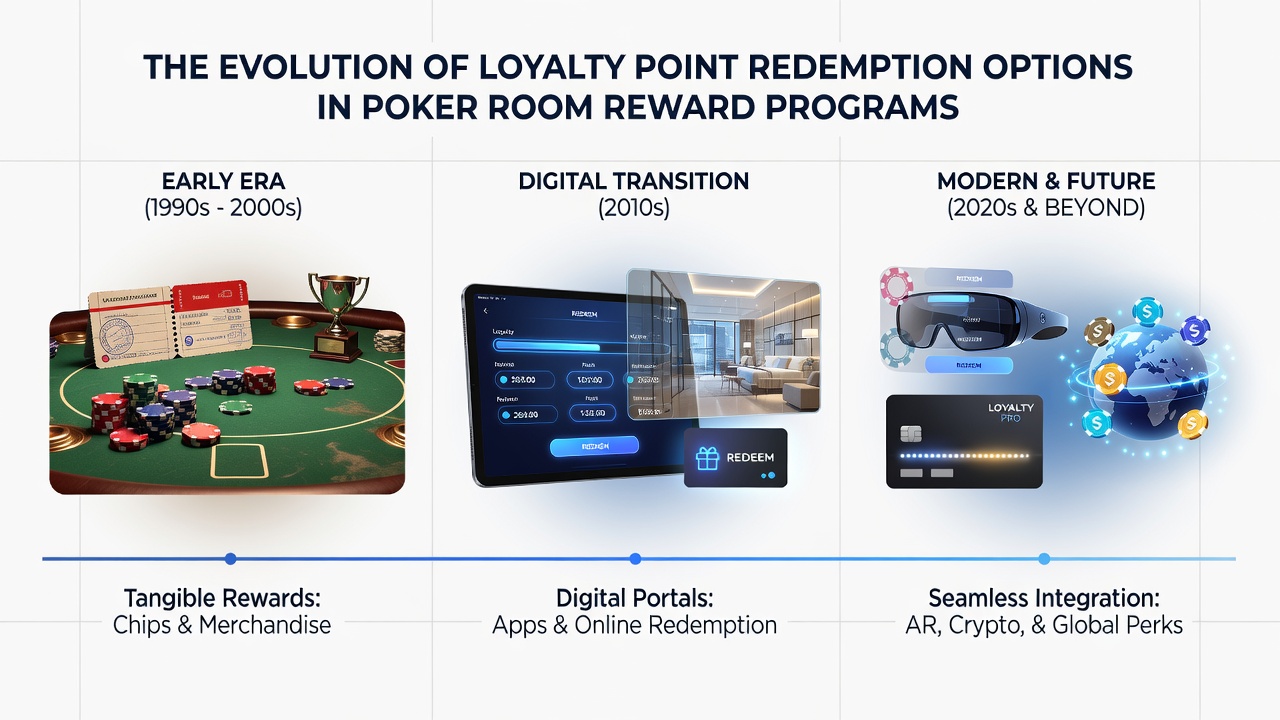
Live poker rooms in August 2026 continue to refine these systems by introducing real-time dashboards that display available redemptions based on current point balances and upcoming events, while online counterparts integrate artificial intelligence tools to suggest personalized options drawn from historical player behavior. The Australian Communications and Media Authority has reported on similar adaptations in licensed poker platforms operating under national frameworks, where redemption flexibility has grown to accommodate both high-volume professionals and recreational participants. These updates reflect broader industry efforts to maintain engagement through varied choices rather than uniform cash returns alone.
Regional Variations in Redemption Availability
Differences emerge across jurisdictions because regulatory environments shape which redemption types receive approval, with some markets permitting luxury item auctions while others emphasize reinvestment into gaming credits. Studies compiled by the European Gaming and Betting Association highlight that operators in multiple EU member states have standardized point valuation across cash, experiences, and charitable giving to comply with consumer protection guidelines. In contrast, programs operating under the Nevada Gaming Control Board maintain stricter oversight on promotional values yet still allow expanded categories that include golf outings and concert tickets at partner venues. Those who monitor cross-border play observe that players often transfer or exchange points through affiliated networks, although such mechanisms remain subject to operator-specific rules and regional restrictions.
Conclusion
The trajectory of loyalty point redemptions in poker rooms demonstrates consistent expansion from narrow cash-based systems to multifaceted selections that incorporate merchandise, events, travel, and community-oriented options, supported by data from regulatory bodies and academic institutions across North America, Europe, and Australia. Continued integration of digital tools has enabled operators to present dynamic menus that adapt to player preferences while remaining within established compliance structures. As programs evolve further, the available redemption landscape will likely continue reflecting both technological capabilities and the distinct requirements of each regulatory environment.